
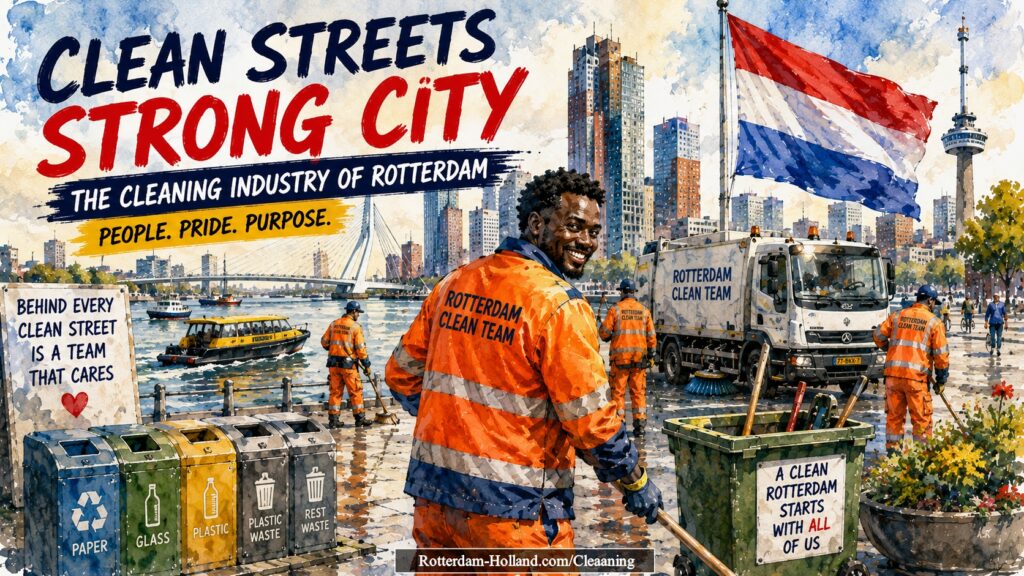
For most of my life in Rotterdam, I walked through clean streets, clean parks, clean neighborhoods, and clean public spaces without fully appreciating what it took to keep them that way. Then I had the opportunity to work behind the scenes in the cleaning industry, and everything changed. I discovered that cleaning in Rotterdam is not simply about picking up rubbish. It is a massive operation involving trained professionals, advanced technology, recycling systems, waste management, graffiti removal, and endless organization. As someone with roots on the West Coast of Africa, I could not help comparing what I saw in Rotterdam with what I had experienced elsewhere. The contrast fascinated me. This is the story of what I learned inside Rotterdam’s invisible cleaning machine.
Rotterdam Looks Clean Because Thousands of People Refuse to Let It Become a Dumpster
When people visit Rotterdam, one of the first things they notice is how clean the city feels. They see the modern buildings, the wide streets, the shiny trams, the beautiful parks, and the waterfront. What they do not see is the invisible army working every day to stop the city from turning into one giant rubbish heap. I have lived in Rotterdam since the 1990s. I have walked these streets for decades. More importantly, I have worked behind the scenes in the cleaning industry. I have seen what most people never see. I have worked with people whose job is to clean graffiti, remove rubbish, sort waste, clean public spaces, and keep entire neighborhoods from collapsing into chaos. The funny thing is that many Rotterdammers have no idea how much effort goes into keeping their city clean. They think cleanliness simply appears like magic. It does not. It appears because somebody wakes up at six in the morning and gets dirty so everyone else can enjoy a clean city.
Most People Think Cleaning Is Simple Until They Actually Have To Do It
One of the biggest myths I discovered is that people think cleaning is easy. Everybody claims they know how to clean. Then they get a cleaning job and suddenly discover that professional cleaning is a completely different world. In Rotterdam there are procedures, certifications, safety rules, equipment, chemicals, machines, and training programs. You cannot simply arrive with a broom and start pretending to be a cleaning professional. I have met many newcomers who were shocked when they learned they had to attend courses and training sessions. Some even laughed when they first heard it. A few weeks later they stopped laughing. Cleaning in Rotterdam is a profession. The city expects standards. The benches, the parks, the staircases, the sidewalks, the windows, the graffiti covered walls, and the public spaces all require different methods. Civilization turns out to be a lot more complicated than simply pushing dirt from one place to another.
Roteb Is Much More Than A Cleaning Company
When most people hear the name Roteb they imagine a truck collecting rubbish bags. That is like saying a hospital is just a building where people sleep. It completely misses the point. Working around Rotterdam’s cleaning operations taught me that there are layers upon layers of activities happening behind the scenes. There are teams that clean streets. Teams that remove graffiti. Teams that maintain parks. Teams that collect household waste. Teams that process furniture. Teams that repair reusable items. Teams that manage recycling streams. Teams that monitor public spaces. Rotterdam’s cleaning operation functions more like an environmental corporation than a traditional cleaning company. Every department connects to another department. Every process connects to another process. It is a giant machine that never sleeps. The moment it stops, the city begins to look very different very quickly.
My Eye Opening Experience Inside A Recycling Company
One of the most fascinating experiences of my life was working inside a recycling company that processed waste from Rotterdam. Before that experience, I thought rubbish disappeared after collection. Like many people, I never thought much about what happened next. Then I saw mountains of waste arriving every day. Plastic. Paper. Metal. Cardboard. Electronics. Furniture. Everything imaginable. Workers sorted materials with incredible precision. Machines compressed waste into giant blocks. Buyers arrived from different European countries to purchase these materials. Suddenly I realized that rubbish was not rubbish at all. It was business. It was trade. It was logistics. It was industry. Rotterdam was not simply cleaning the city. Rotterdam was transforming waste into economic value. That realization completely changed how I looked at urban life.
Rotterdam Sells What Other Places Throw Away
Coming from a West African background, this part fascinated me the most. In many places waste is viewed as a problem. In Rotterdam waste is often viewed as a resource. That difference changes everything. I watched recyclable materials get sorted, compressed, packaged, and sold. Companies from different countries bought materials that ordinary citizens had thrown away. The city collected waste. Private companies processed it. International buyers purchased it. Everybody in the chain created value. It was one of the smartest systems I had ever seen. Sometimes I stand back and laugh at the absurdity of it all. One person’s unwanted refrigerator becomes another company’s business opportunity. One person’s rubbish bin becomes somebody else’s paycheck. Capitalism has many strange talents. Turning trash into money might be one of its most impressive tricks.
The Graffiti Removal Teams Fight A Daily War
One of the departments I worked with focused on graffiti removal. Many people think graffiti is harmless. Maybe some of it is art. Maybe some of it is self expression. Maybe some of it is simply boredom with a spray can. Whatever the reason, somebody eventually has to clean it. I spent time helping remove markings from walls, buildings, fences, and public infrastructure. It taught me something important. Clean cities require constant maintenance. You cannot clean something once and expect it to remain clean forever. There is always another tag. Another sticker. Another act of vandalism. Another mess. Civilization is a never ending battle between people who build and people who damage. The cleaners sit in the middle trying to keep the peace one wall at a time.
The Parks Do Not Clean Themselves
Rotterdam has beautiful parks. Families enjoy them. Children play in them. Tourists photograph them. Residents relax in them. What many people forget is that parks attract rubbish as naturally as honey attracts flies. Plastic bottles appear. Food containers appear. Paper bags appear. Strange objects appear. Sometimes I genuinely wondered how certain items ended up in places where they clearly had no business being. Cleaning crews move through these spaces constantly. They empty bins. Pick up litter. Wash surfaces. Maintain benches. Remove dirt and grime. Without them many parks would become open air dumping grounds within weeks. Human beings love nature. Human beings also have an astonishing ability to leave rubbish behind while claiming to love nature.
The Hidden Cost Of A Clean City
Many people complain about taxes in Rotterdam. Every year the waste collection bill arrives and people grumble. I understand. Nobody enjoys paying bills. But having worked inside the system, I also understand where the money goes. Trucks cost money. Fuel costs money. Equipment costs money. Training costs money. Salaries cost money. Maintenance costs money. Recycling facilities cost money. The technology behind modern waste management costs money. Clean cities are expensive. Dirty cities are expensive too. The difference is that dirty cities eventually pay the bill through poor health, lower property values, pollution, and social decline. Rotterdam chooses to pay upfront. That decision is one reason the city remains attractive despite all its imperfections.
What Rotterdam Taught Me About Society
The cleaning industry taught me lessons far beyond rubbish and recycling. It taught me about organization. It taught me about trust. It taught me about accountability. It taught me that successful cities depend on thousands of ordinary people doing ordinary jobs extremely well. Politicians often stand in front of cameras talking about grand visions. Meanwhile a cleaner quietly removes rubbish from a street corner and improves the city more in five minutes than some politicians manage in five years. That may sound cynical. It probably is. Decades in Rotterdam have taught me that speeches rarely clean sidewalks. Systems do. Workers do. Maintenance does. The boring things matter far more than most people want to admit.
The Invisible Machine That Keeps Rotterdam Alive
The longer I live in Rotterdam, the more fascinated I become by the invisible machine operating beneath the surface. Every clean street tells a story. Every empty rubbish bin tells a story. Every graffiti free wall tells a story. Behind each one stands a worker, a vehicle, a budget, a training program, a maintenance schedule, and an entire system of organization. Most residents never think about it. Most visitors never notice it. I notice it because I have worked inside it. I have seen the machinery. I have seen the people. I have seen the effort. Rotterdam is not clean because the Dutch are magical. Rotterdam is clean because thousands of people work every day to make it clean. It is one of the city’s greatest achievements and one of its best kept secrets.
Conclusion and Reminder about Cleaning in Rotterdam
After years of living and working in Rotterdam, the cleaning industry taught me something that goes far beyond rubbish, recycling, or spotless streets. It taught me the importance of maintenance. Many cities love building impressive projects, but far fewer know how to maintain them. A clean park, a clean staircase, a graffiti free wall, or an empty rubbish bin does not happen by accident. It happens because trained people show up every day and do the work. That is the real lesson I learned from Rotterdam. Building something is the easy part. Maintaining it year after year is where character, discipline, organization, and civic pride truly reveal themselves.